Home / Wood guide / American Black Walnut
Wood 9 of 21
American Black Walnut
Rich chocolate brown with beautiful grain. The most popular dark wood for fine furniture and cutting boards.

Color over time
Approximate, in a normally lit room. Illustrated grain; real boards vary.
- Hardness
- 1,010 MediumHigher number means harder to dent. About the Janka test
- Weight
- Medium
- Cost of the wood
- $$$Premium, per board foot
- Grows in
- Eastern United States
What it looks like
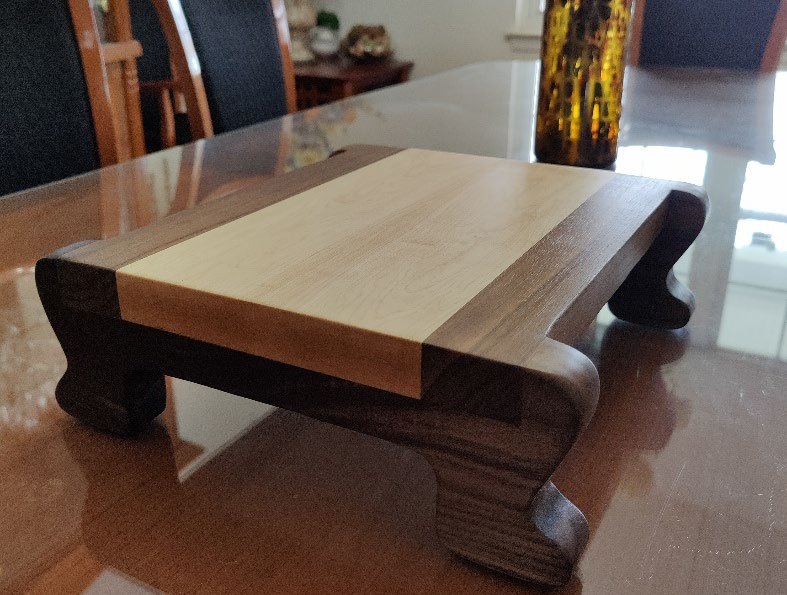
Light to deep chocolate brown. The outer part of the tree is creamy white and shows as a pale stripe when it’s left in. Some boards have wavy or feather-like patterns.
How it changes over time
Walnut does the opposite of most woods: it gets lighter. Over the years the chocolate turns a warm honey-brown. In a sunny spot this shows in 2 to 3 years; out of direct sun it takes 5 to 10.
Shimmer
A nice glow on plain boards; wavy and feathered boards shimmer much more.
Smell
A faint, earthy smell when cut; none once finished.
With a natural wax finish
A soft, matte, slightly grayish brown. With an oil under the wax, the color gets much deeper and richer.
With a semi-gloss lacquer finish
Makes the chocolate color and the grain pop right away.
Safe for food?
Looks great with
- Hard Maple: the classic light-and-dark pair
- Cherry: a warm pair; the colors grow closer within 5 years
- Curly / Quilted Maple: shimmering maple panels in walnut
- White Oak: the modern staple; both hold their color
- Padauk: red on brown, popular in cutting boards
- Purpleheart: purple accents; both slowly turn browner